Building Blocks Part 2: Design the Experience
Dec 1, 2025
The Building Blocks of Onboarding is a practical guide to designing onboarding that connects people, culture, and performance.
This is the second article, focusing on where to start.
All Articles
Intro: What this series is about (& why onboarding is important)
Part 2: Design the Experience (this)
What should you cover? The 4 C’s of Onboarding
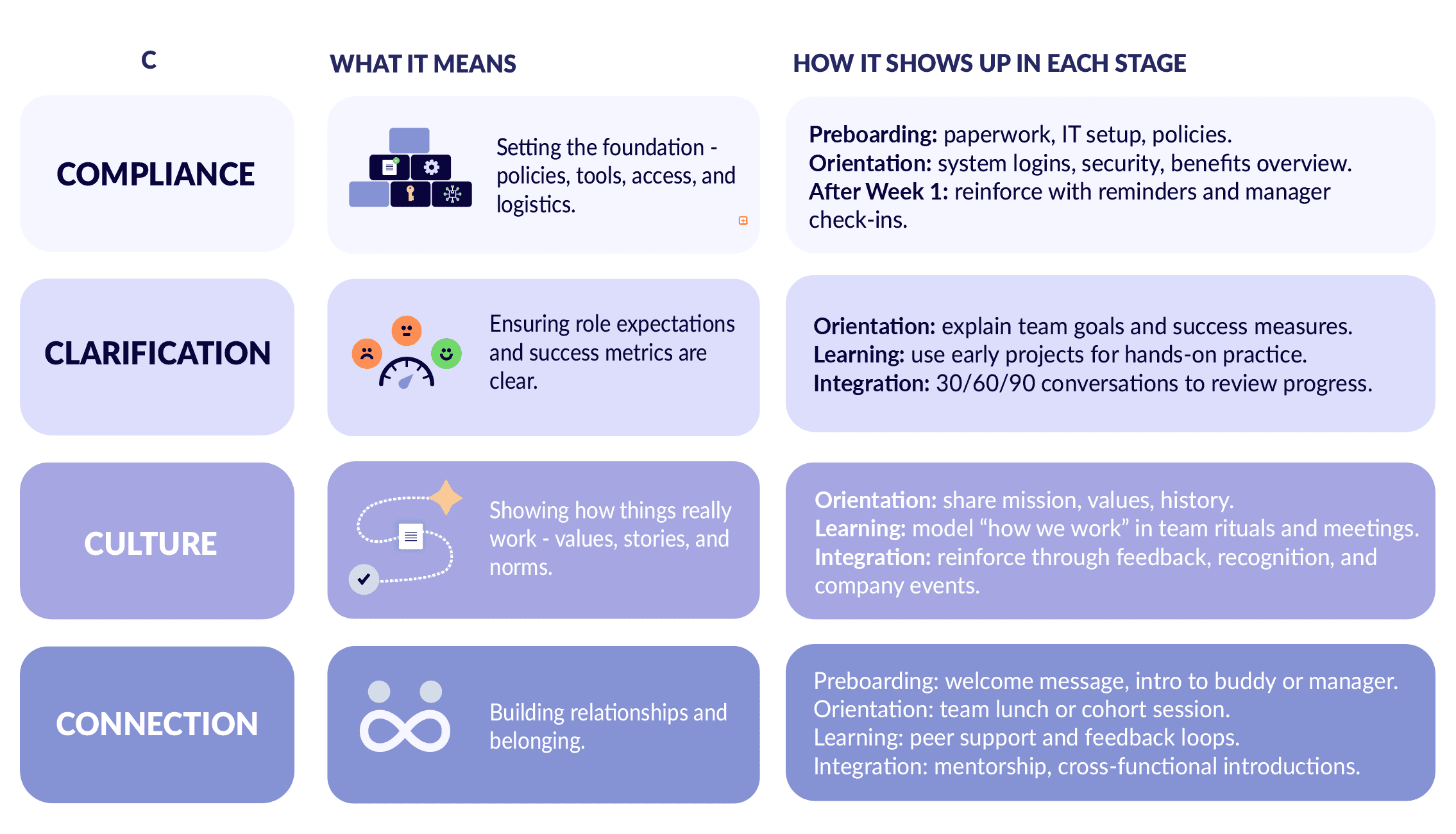
Every effective onboarding program intentionally reinforces four essentials: Compliance, Clarification, Culture, and Connection.
How they show up should evolve across the onboarding journey.
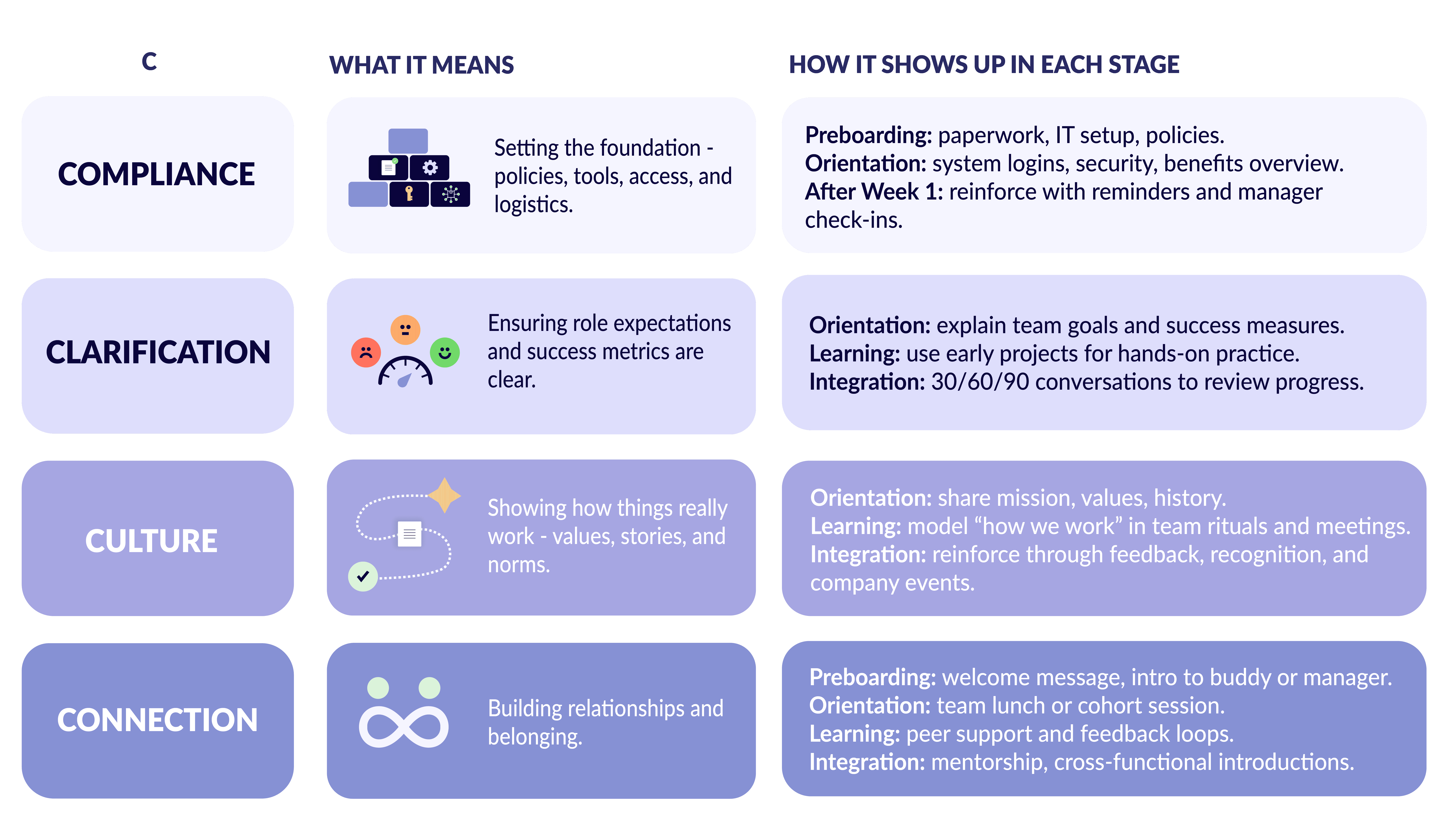
Use the 4 Cs as your quality lens for each stage of the onboarding journey.
If a stage doesn’t hit at least two Cs, it’s probably too transactional.
Transactional onboarding focuses only on tasks and information. Transformational onboarding blends logistics with culture, context, and relationships.
What People Often Get Wrong | What to do instead |
|---|---|
Thinking “Company Orientation” is onboarding | Ensure the hiring manager is set up to guide the new hire. Have role specific conversations. Train in their specific role/area. "Walkthroughs" by teammates is a highly effective way of supporting someone. |
Overloading week one and starving weeks 2–6 | Ensure there are touchpoints and sessions past week 1. Think about what information is required for week 1, and what can wait to later weeks and schedule the delivery of it (either in a synchronous meeting or via message/email). Re-engage after 30 days with important information, even if it's being repeated. |
Measuring completion rates instead of confidence and belonging | Tasks getting done is an ok measure, as it's important to have them progress. But more importantly, set up check ins and surveys, not only for the new hire but also the manager. |
Expecting HR to carry culture alone | Teammates, a buddy, and their manager play a big role in this. Leaders should be meeting with new hires (as a group or 1:1). Coworkers can be great ways to deliver information and drive belonging. |
Forgetting that “clarity” requires repetition. | Repeat important things multiple times, and over multiple timeframes. Resend an email at day 30 re-iterating important points. |
✳️ Try this: Audit your current onboarding flow.
For each Stage (see more details below):
Preboarding
Company Orientation
Ramp-Up
Integration
Ask the question:
Are we covering at least two of the 4 Cs?
Which C are we strongest in? Which do we ignore?
=> Use this as your quick “quality check” before adding anything new.
Map the Journey
Think of Onboarding as a Journey Map (wayfinding + human moments).
It has multiple stages, which starts at offer signing and ends when they are a fully integrated, contributing employee (usually between 6 and 12 months).
Onboarding is a bridge between promise and practice. The recruiting process makes promises, and onboarding is where you prove them.
Each stage should integrate the 4 Cs and have clear ownership.
Together, these lenses (stages, content) create an onboarding program that is structured, human, consistent and scalable.
Ownership matters because it spans both what you cover (company, role, team) and when you deliver it across the stages.
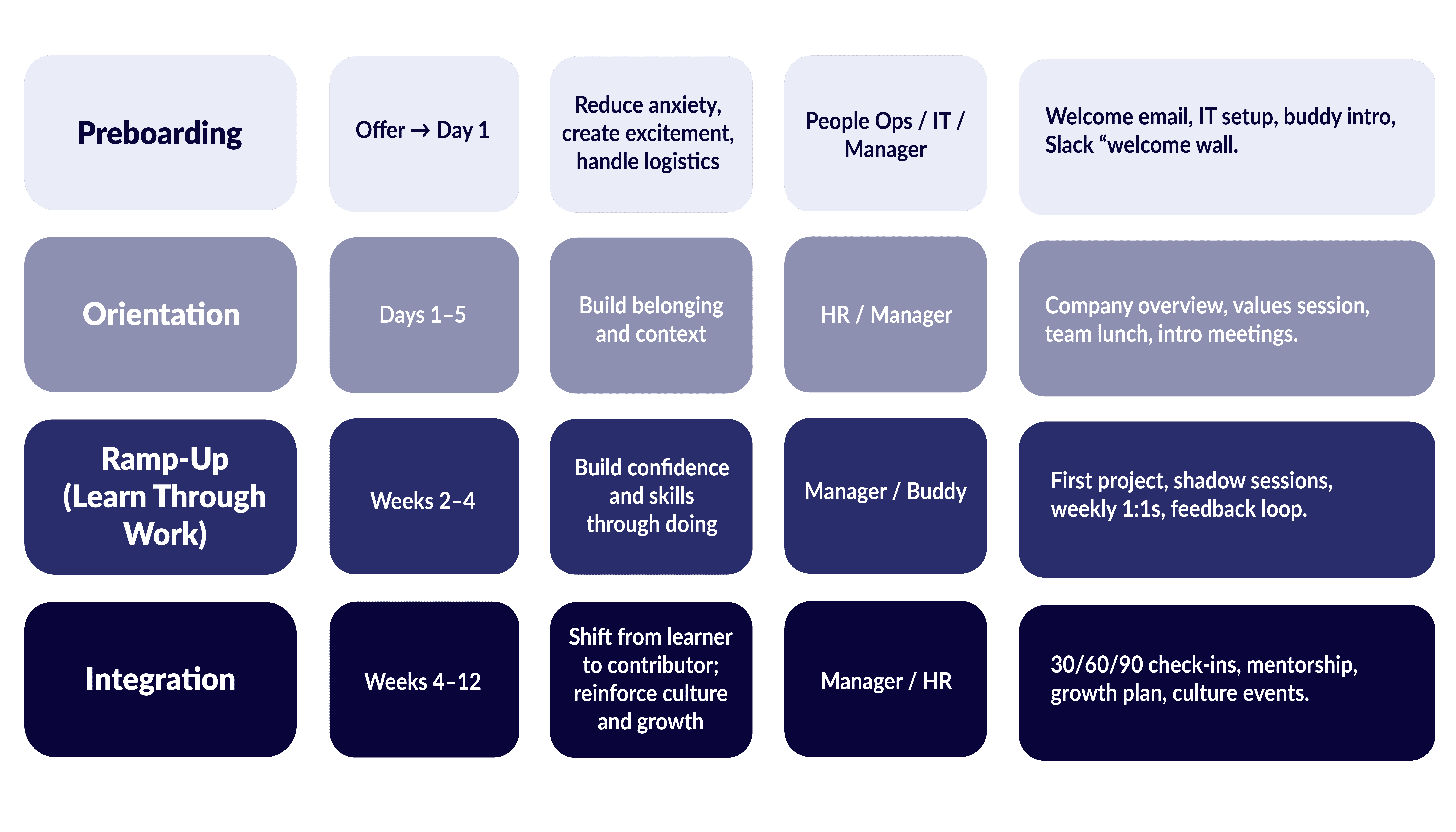
(Optional But Powerful Stage) Sustainment (90 Days – 1 Year) – Keep momentum with learning sessions, mentorship, and “stay” interviews.
✳️ Try this: Sketch your onboarding journey as a timeline from Offer → Day 90.
Define the phases and what they look like at your company. Then layer in:
Who owns each phase
Which 4 Cs are covered
What human touchpoints exist
Your gaps should jump off the page.
Build in Human Touchpoints
It’s less about what was covered, and more about how they felt.
Perception plays a huge role in how effective the onboarding is. A new hire is more likely to say they had a ‘great onboarding experience’ if they felt their manager took an interest and was available in their onboarding.
People don’t remember the slide decks, they remember the moments. It’s important to design for connection and reflection alongside logistics.
Some recommended touchpoints:
Manager 1:1s: Multiple times a week for the first month. Specific "question answering sessions".
Buddy Program: Pair new hires with peers for informal support.
Cohort Sessions: Encourage reflection and connection across new hires.
Welcome Rituals: Intros, shared lunches, welcome notes, introducing selves at all hands - Help New Hires build relationships with their workmates.
These small, intentional moments are important for making the new hire feel connected and the intentionality required for them to say their onboarding was great.
✳️ Try this: Define the human moments in each stage.
Ensure each stage has a human moment!
You’ll be surprised how much warmth those simple additions create.
Wrapping it up
When onboarding is intentionally designed, it more than information, it delivers belonging. Clear purpose, shared ownership, and thoughtful pacing turn “getting started” into “feeling at home.”
Here’s your challenge: Pick one stage of onboarding, clarify ownership, and make sure it hits at least two of the 4 Cs. Start small and build on it.
Additional things you could try:
Audit Using the 4 Cs – for each stage, ask if you’re hitting compliance, clarification, culture, and connection.
Clarify Ownership – map out who owns what (HR, manager, team) and share it.
Map the Journey – outline Preboarding → Orientation → Learning → Integration, with goals for each.
Document Your Human Touchpoints – buddies, manager 1:1s, cohort sessions, or small rituals that build belonging.
What’s Next
After this structure is in place, you can then start building out how onboarding will be delivered (the session design, feedback loops, and automated delivery that make it scale). In future articles, we’ll get even more tactical, including posts on:
How to design sessions that drive learning and connection
How to measure what’s working and iterate
How to automate logistics while keeping it human
Thanks!